
The Meriwether County Courthouse sits proudly in the middle of the town square. Turn on either side to find one of a few churches, and keep driving to see a small, triangular brick building that houses the public library. If you happen to spot a few people while on the road, there’s a good chance the second person you see knows that first person’s name, birthday, and how their children are doing.
That’s probably what Mark Fox and Phillip Pearson saw on their first drive through Greenville, Georgia. They might also have passed by a Dollar General, or maybe even that BP gas station with the Hunt Brothers pizza inside, but they weren’t here to sightsee. They had a struggling basketball program to turn around.
The men drove for about an hour and a half until they reached Greenville High School. They turned toward the parking lot and hopped out of their car. The coaches, both wearing well-tailored sports coats, walked inside the high school to the excitement of the many teachers, coaches, students, and staff members who watched them walk in. Representatives from the University of Georgia were here? In Greenville? They were. And almost everyone in that building could guess why. It was in this building on that Friday when Fox and Pearson first met a shy tenth grader who didn’t talk all that much. He didn’t need to. His game told the country everything it needed to know.

ONE:
Sweat drips from the boy’s forehead. He’s bouncing the ball in perfect rhythm as he waits for an opening. The tap … tap … tap …ofthe ball on the court could lull you to sleep. Just when you think you’ve got him, he’s already made a mad dash toward the hoop. It’s too late now. Those two points were always his to score.
That hoop has seen way too much of the young Kentavious Caldwell. The two have grown very well acquainted throughout the boy’s childhood. It stood high above the basketball court next to the elementary school and waited for the children to storm out of the building. Once that final bell rang, Caldwell and his best friend, Kenarious Gates, would make a beeline toward that court and spend their afternoons playing basketball on it. The sun would sometimes leave the court before Caldwell did. He didn’t need it for his day to be brightened. A court and a basketball were more than enough.
“If [Caldwell] was going to be somewhere,” said Kenzie Gates, Kenarious’ mother, “You’re gonna find him at some basketball court.”
It would be a while before Kenzie Gates saw the boys. Not that she ever worried. She expected not to hear a knock on her door until hours after the final bell rang. When she did hear that knock, she’d scurry toward the door to find Caldwell, his brother, and Kenarious, exhausted from an afternoon well-spent on the court. It was always a pleasure for her to welcome them inside. They were never any trouble to take care of. Most of the time, they would play video games before the Caldwells returned to either their grandmother’s house next door or to their mother’s house across the street. If she ever needed everything from Caldwell, he would always respond with an emphatic “yes, ma’am” and a huge smile on his face.
That smile remained on his face throughout high school. It must have shown up at least a few times whenever his grandmother agreed to open the gym’s doors for him once school ended. That’s one of the many perks of being related to the janitor at your high school. He could keep busy playing the sport he loves until she finished cleaning the school’s floors.With any luck — and a considerable amount of hard work — this love could turn into more than just a passion. If Caldwell’s love for basketball was going to end with an NBA championship ring on his finger, those fingers needed to be putting basketballs inside those hoops until then.
If that somehow wasn’t his mindset, he would have fooled his head coach. Richard Carter would sometimes walk into practice and greet his star guard, who likely would have been in the middle of taking warmup shots by himself. A common start to an afternoon ever since Carter first observed Caldwell’s passion for the game as a seventh-grader. This passion made it easy for the otherwise quiet Caldwell to help a teammate understand a certain drill or show him where to move on the court. It also seemed to make his spirit impervious to any and all punishments. Not even suicides were enough to slow him down. Anytime Carter made his team run, Caldwell made it a point to run faster than everyone else in the gym.
“He absolutely always made it a point that he was going to lead the pack,” Carter said. “He was not going to be behind.”
There were only a few basketball-related skills and traits Caldwell hadn’t grasped before ninth grade. That short list had “jumpshot” written all over it. Carter noticed that Caldwell would hold the ball close to his stomach before flinging it into the air as soon as his feet left the ground. That wouldn’t fly. Well, it would — just not into the hoop. When Caldwell’s ninth-grade season ended, Carter approached the boy and told him he needed a “big boy shot,” and began helping him refine his mechanics for a completely new form.
It needed a little time in the oven. Carter’s heard his fair share of “Coach, I can’t make nothing!” after Caldwell’s first few shot attempts with his new form. But when that shot was ready, it came out scalding. Just ask Auburn High School about their rude introduction to Caldwell’s new form. At least ask the player who found Caldwell walking off the court after the halftime buzzer concluded a first-half barrage of swish after swish from Caldwell’s jumpshot.
“Hey, man,” the player said, “How about missing one of those shots?”
Caldwell obliged. He grabbed the ball, turned around, and threw a mid-court shot at the hoop, where it clanged on the front of the rim.
“That’s your one miss right there,” Carter said. Caldwell told the player.
Word of this gifted basketball player from Greenville began to spread across the state. Players from opposing schools would see Greenville on their schedule and feel a rush of adrenaline. “We’re playing Kentavious?!” they would ask before Caldwell torched them with several points on a given night.Each swish would only spread word of Caldwell’s greatness further away from Georgia. What was once a secret between those who sat in Greenville High School’s bleachers had been shared across the nation to scouts, colleges, and those who curated lists of the top American basketball recruits for the Class of 2011.
They all knew that this was no longer just a pretty good kid from a tiny school. This could be a future NBA player if everything went right on his way to get there. Those words don’t get thrown around that often, even for young players who earned as much respect from experts as Caldwell did. Not even earning playing time in the prestigious McDonald’s All-American Game — which Caldwell achieved in his senior year — can guarantee you a spot on an NBA team’s roster. That’s an honor reserved for freakishly talented basketball players who possess an insatiable desire to coach, be coached, and work hard enough that coaching stops becoming necessary.
The best basketball players possess some of these traits, but only a select few can master them all. That combination can only be seen in just a few cities every year, and that’s why scouts travel all across the country to find it. And as Caldwell’stalentkept filling up many of the gyms he visited, it started to look like this impossibly rarecombination could be found inside Greenville High School.
That possibility made this multi-hour work trip across the state of Georgia feel like an effortless drive for Fox and Pearson. That would have been the only effortless aspect of their new jobs. Fox left behind the life he built in Nevada to become the University of Georgia’s next head coach, and Pearson had to depart from Tuscaloosa and cross SEC lines before becoming Fox’s assistant. All this to turn around a struggling basketball program perpetually overshadowed by a dominant football program. They knew that couldn’t happen without completing the unenviable task that the football team does every year: recruiting the best talent they could find.
There was a good chance they’d find such a talent within their state’s borders. Pearson had been keeping tabs on Caldwell and suggested they include Greenville on their first scouting trip across the state together, which they planned for a Friday afternoon just two days after they were hired. They only needed that one Friday afternoon to meet the tenth-grader, talk with those who coached and taught him, and promptly fall in love with the prospect of him wearing a Bulldogs jersey. It didn’t take much longer for them to realize that Caldwell was the type of player that many schools would devote significant resources to recruiting. And they were right. Florida State wanted him. Virginia Tech wanted him. Some scouts even wanted to put him on the gridiron for his exceptional skills as a wide receiver. Fox and Pearson weren’t going to get him so easily. They left Greenville that day knowing that if they wanted him, they would have to earn him.
So that’s exactly what they did.
That Friday was the first of around eight to ten visits they would make to visit Caldwell over the next three years. They didn’t just want to visit him. They wanted to know him. Fox and Pearson befriended everyone in Caldwell’s inner circle, from coaches to teachers to adult family members to even some elected officials. None of them would have easily trusted a school that wouldn’t have prioritized Caldwell’s personal and basketball development, a promise that Fox and Pearson ensured to them that they would keep. That was an unconditional promise, too. His parents didn’t need to send Caldwell to a prep school far away from home. Caldwell was already more than worthy of the many trips Fox and Pearson made to the town that just about became a second home for them over the next three years.
The coaches still made visits to Greenville throughout Caldwell’s senior year, when the boy’s star power grew bright enough to illuminate the whole country. Georgia hadn’t seen a star that bright since they recruited Dominique Wilkins in 1979, but it wasn’t enough to blind Fox and Pearson from seeing Caldwell as the boy who they met as a tenth grader. They still saw the young man whose little town would stop at nothing to make his star shine.
“Everyone felt like this young man has a chance to make it in life and change the trajectory of an entire community and family,” Fox said. “You could just feel the love that everyone had for Kentavious because he was such a sweet kid.”
Those close to Caldwell — who added his father’s last name, “Pope,” to his surname in his junior year — weren’t blinded, either. As bright as the Meriwether County Courthouse was underneath the sun, the brightness of Caldwell’s future alone would have rendered it invisible. His next destination had to be a place that could not only contain that star, but could keep it bright enough to illuminate a long, successful career of professional basketball.
Those people believe that one school made the most sense to Caldwell. The same school that would have kept him close to the home that raised him. The same school that had turned his best friend, Kenarious, into a stellar offensive lineman for their football program. The same school that wanted to make him their North Star on their journey towards making Georgia basketball the most respected program in the nation.
So Caldwell-Pope committed to the University of Georgia. And the only thing more radiant than its newest star was the excitement of the coaches that helped bring him there.
“We were engaged in what we were doing big time,” Pearson said. “He was just a lot of fun to recruit.”

TWO:
- Stay low to the ground.
- Keep your legs as strong as possible.
- Position yourself to where you’re a strong presence on one leg — not just two.
- Make sure your body is prepared to move toward any direction on the court at a moment’s notice.
Those bullet points fire out of Sean Hayes’ lips and shoot straight toward their targets. He lands direct hits almost every time. Hayes has been firing off advice like this for the better part of fifteen years with the accuracy of a military sniper. And while he may not be a Navy SEAL, the strength and conditioning coach for the University of Georgia could probably turn you into one. His advice not only helps his athletes dodge devastating injury-related bullets, but it also allows them to explode out of the barrel and force opponents to witness the firepower that Georgia has at their disposal.
But firepower is all but useless without a way to ignite it. Hayes’ job is to carry a strong lighter. It takes more than one click to light up an athlete — that process is a slow burn that usually starts during a sport’s offseason, when players get their first tasteof Hayes’ bullet points. There was an outlier during the summer before the 2011-12 NCAA basketball season. One of the incoming freshmen kept taking hit after hit after hit of Hayes’ advice — including some bullets he did not fire.
“He was always very attentive when we were doing things to get better,” Hayes said. “He paid attention to the minor details, which was pretty impressive, being a young kid.”
A flame doesn’t often light this effortlessly. And yet, this kid was just burning through every single drill. It rarely took more than a few tries for Hayes to watch the freshman execute an exact lesson down to its most precise detail. This stopped being a surprise by the time he found out why. Hayes didn’t need to put in any extra effort to burn a flame into a soul that was already well-lit.
“I want to become the best defender on the court at all times,” Hayes remembers Caldwell-Pope telling him.
It’s an admirable ambition. But it would be a significantly taller task than Caldwell-Pope’s six feet and four inches. If he wanted to silence the likes of Bradley Beal and Marquis Teague, he’d have to develop the muscle required just to keep up with them. That just wasn’t going to happen easily with around 190 pounds and a diet that mostly consisted of French fries from the dining hall. Caldwell-Pope could only become that type of a threat after hundreds of hours in the weight room, thousands of reps during practice, and a relentless desire to work that even the most dedicated athletes need a push to see through.
Hayes ended up with a different problem: sometimes he needed to pull the freshman back.
“He pushed himself to always make sure that he never left anything in the tank,” Hayes said. “That’s pretty impressive as a young kid.”
If you ever needed to reach Caldwell-Pope that season, you could send any mail to the University of Georgia’s weight room. He would probably be in the middle of a set that anyone watching knew wouldn’t be his last. There were always a few more plates he could add. How many? It didn’t matter. No number was too big, and every number seemed too small. Including the number Hayes suggested Caldwell-Pope squat near the end of one of their workouts together. Caldwell-Pope’s immediate response was, “What’s Gerald [Robinson] doing?” Hayes told him a much higher number. So the freshman insisted that he hit Robinson’s number for that final set to ensure he could keep up with his older, much more experienced teammate.
That barbell went down without any trouble.
“It was [to] the point of, ‘How strong is strong enough for him?’” Hayes said. “And I didn’t want to create a physical imbalance and slow him down. He just loved everything.”
Caldwell-Pope always took his relentless drive outside of the weight room. Fox considered sitting his star guard out of several drills to prevent an unfortunate injury from happening so close to a game. Fox’s fears were often warranted. It wasn’t rare for the freshman to run far past his speed limit, even in instances when coasting would suffice. He would treat 45-minute workout sessions as warmups for another hour of going through the same drills. Very rarely would Caldwell-Pope finish a workout or practice with, “I’m done.” His coaches would sooner hear, “What’s next?”
That’s a question that Caldwell-Pope has always seemed eager to have answered. His older teammates could see that question plastered all over the freshman’s body, from the University of Georgia apparel that covered his body during his first few team meetings, to the smile that accompanied the outfit. He didn’t talk all that much during those early meetings, but he didn’t need to. His passion for basketball was immediately very obvious to his new teammates, especially senior guards Gerald Robinson and Dustin Ware. They welcomed the freshman to Athens by inviting him to the gym with them, and they pushed him to stay longer than he planned to. Soon, no one could successfully pull him out of it. They made very few attempts to do so, if any.Coaches sometimes told players that Caldwell-Pope had already put up 500 shots on the shooting machine when they walked in for their workouts. Anyone who wasn’t already planning on doing the same would feel inclined to change that.
“He lived in the gym,” said Sherrard Brantley, Caldwell-Pope’s teammate. “He [was] always getting shots up and working on his game, at times where I didn’t even know he had been to the gym already.”
Not that they needed to see him to believe him. Caldwell-Pope’s hard work manifested in the 13.2 points, 5.2 rebounds, and 1.2 assists he averaged in his first year as a Bulldog. It was certainly an impressive freshman season … but not a perfect one. Adjusting to a slightly more off-ball role gave him some trouble connecting with the hoop that season. He shot just 39.6% from the field, and 30.4% from behind the three-point line. The much more difficult competition he faced often tested his defensive instincts as well, especially away from the ball. He passed most of those tests, with special help from all of that coaching he received. But there were times where he watched the ball a little more than coaches would have liked, allowing his opponents to make easy cuts to the basket within the split second Caldwell-Pope had to notice.
And yet, there were plenty of moments in which opponents could see the McDonald’s All-American that Caldwell-Pope was just a year prior. He earned a spot on the 2012 All-SEC Freshman Team and showed flashes of that unique NBA-worthy talent that he and his community believe he had. But did he show enough of that talent to leave campus and risk entering the 2012 NBA Draft? It didn’t matter. That didn’t seem to be in Caldwell-Pope’s mind at all.
“I think he felt like, ‘I need to get better, I need to keep growing,’” Fox said. “I don’t remember [declaring for the draft that year] being something that was a real serious consideration.”
Caldwell-Pope’s main consideration was the season that lay ahead for the Bulldogs. It would require him to sleep in a college dorm again, but no longer as a wide-eyed freshman excited to start a new phase of his career. Next year, he would arrive in Athens with an even greater desire to prove that the NBA could find that rare combination of freakish talent and freakish work ethic inside the boy from Greenville.
And there weren’t many people around him with any doubts that he could do so.
“I thought I knew what a pretty good player looked like,” Pearson said. “I think we felt all along that Kentavious was going to be able to advance into the NBA.”

THREE:
The Mann family parked the family Suburban near a vast brick building that dwarfed the trees surrounding it. Charles Mann Jr. exited the vehicle and took out a few of the many boxes that clogged its trunk. He closed the door and joined his parents as they walked toward his new home: Busbee Hall. The place he’d return to after long practices and tedious lectures. His soon-to-be respite after a tough night fending off the many suffocating point-of-attack defenders the SEC would soon throw at him. The building where he’d make his first few memories as a University of Georgia student.
As the Manns reached the security entrance of Busbee Hall, a tall young man wearing a University of Georgia T-shirt, gym shorts, and a pair of flip-flops came down from the sixth floor to join them. He introduced himself to the Mann family with a smile and joined them on their walk back to their car. This was no stranger; Mann had already met his new roommate on his first official visit. But as Caldwell-Pope and a few of their coaches helped the Mann family unload boxes from their car, Mann got to see the soul behind the face of their basketball team. Each trip up Busbee Hall’s elevator was a five-minute comedy special hosted by Caldwell-Pope, whose smile did not fade while they set up Mann’s new room, their kitchen, and the common area they would share.
The final thing Caldwell-Pope helped Mann set up was an atmosphere of enthusiasm throughout the dorm. That installation process takes much more than one afternoon, but the time made the work even more fun. They both made a genuine effort to make their common area an excuse to leave their individual rooms. It became a place where they could feed each other’s competitive spirits through yet another round of NBA 2K or Call of Duty. It was a room where they could throw a party on a Friday night before opening up to one another on Saturday morning. And above all, it was a place where Mann could see that Caldwell-Pope cared for him as more than just a basketball player.
“He was kind of like a big brother to me, coming in as a freshman,” Mann said. “They paired me up with him, so I definitely looked up to him and kind of wanted to follow in his footsteps, the way he did things.”
The dorm became a much-needed place for Caldwell-Pope to let loose and relax after another brutal practice that he inflicted on himself. Mann admired how the sophomore seemed to push his body to its absolute limits every time they stepped foot onto the court or in the weight room together. His body could handle it. He made sure of it. Any time something seemed off, he’d get it checked out. Even teeny, nagging injuries warranted a visit to the trainer. Otherwise, Mann could find his friend inside the cold tub, freezing away the pain he had just put his body through.
If Caldwell-Pope pushed himself that far, then Mann could do the same. So he did. Anytime he saw Caldwell-Pope hustle, he hustled just as hard. Any time he watched Caldwell-Pope push through a difficult rep in the weight room, he would do the same. That task wasn’t always easy. Some of his weight room sessions were strenuous enough for Mann to consider skipping his final set. In those moments, all Mann needed to do was look at Caldwell-Pope. The vicious side-eye the sophomore would give him would always send his body right back onto the bench and lock his fingers around the weights. And then sometimes right back onto that bench again for another set.
“He’d look at me and be like, ‘Nah, we ain’t doing that,’” Mann said. “It just made me want to push through and maybe want to finish strong and kind of follow the lead in which he was leading.”
Caldwell-Pope didn’t need to open his mouth for his teammates to listen to him. Kenny Gaines has heard enough of Caldwell-Pope’s “encouragement” to last a whole basketball career. Gaines used to cherish the few games that his Whitfield Academy basketball program played against Greenville. Those were the only opportunities he had to place his crosshairs onto the highest-ranked recruit he would ever face. Sometimes, his lockdown defense would land a direct hit. Other times, the missile Caldwell-Pope had for a jump shot proved stronger. Win or lose, Gaines would leave the court knowing that he made it his mission to conquer the enemy and make it a living hell for Caldwell-Pope to score the basketball.
There was never any malice between the two guards. They always ended every game with a greater level of respect for one another and maybe a brief, “Looking forward to playing you again.” Gaines would enter his senior season of high school without such an opportunity — that was the year Caldwell-Pope became a Bulldog. But Caldwell-Pope wasn’t able to shake off Gaines for too long, though. One season later, Gaines committed to the University of Georgia and committed to terrorizing Caldwell-Pope only in practice.
The competition between the two remained fierce in those practices. Gaines still wanted to get the best of Caldwell-Pope, but not as an opponent. Gaines wanted to prove that his talent and skill matched that of the program’s star guard. Caldwell-Pope wanted to show Gaines how difficult college basketball was going to be for the freshman. Both let nothing come easy for either player. And both made each other better at the sport they loved because of it.
“It was really iron sharpening iron, and we both had a chip on our shoulder,” Gaines said. “He had one because he didn’t want the young buck to come in and steal the show, and I had one because I was the young buck trying to come in and steal the show.”
A shift in the relationship between these twocompetitors would occur during each moment they spent together. No longer did they see each other as competitors, but as brothers. And as most brothers do, they opened up to one another. About goals. Hopes for their futures. Bucket list items that the two college students were too young to complete. That wouldn’t stop the boys from dreaming about them. Getting close to most of these dreams would take Caldwell-Pope further away from the Meriwether County courthouse than he already was. There was no telling where his first stop on his NBA journey would be. There was even less of a way to know who would help him raise the happy family of 12 kids he wanted to have one day.
But there was one goal that he could accomplish no matter where in the world he was. That was the goal he talked about accomplishing the most. More than anything else in the world, Caldwell-Pope wanted to retire his parents. Many of his most formative experiences and fondest childhood memories don’t happen if Rhonda Caldwell and Lawrence Pope don’t make the sacrifices they made. They worked so hard to ensure that the NBA could recognize the unique talent that their son possessed. As soon as an NBA team calls his name, he would make sure they would never have to work again.
Of course, Caldwell-Pope would want to change the lives of his family. He’s already done many, many, many small, but meaningful things for others in his sophomore season alone. Teammates have used his motivation to complete that extra step. Friends know he listens to them whenever he gives them his ear. If there’s anything he can do for someone he cares deeply about, he would do it, often without anybody asking him.
You’ll knowif you’re part of that inner circle. Upon forming a brotherly bond with Caldwell-Pope, your perception of him shifts. No longer is he the reserved, yet friendly basketball player willing to give a hi-five or a helping hand that so many people perceive him as. He transforms into a goofy man who laughs and cracks jokes any time he can. Caldwell-Pope’s Georgia teammates heard several of these jokes during his sophomore year. They didn’t know Caldwell-Pope the McDonald’s All-American. They knew a man who routinely made terrible fashion choices and awful dance moves. The best friend they could have ever asked for.
“He brought the ‘kid’ [version of himself] out all the time when he was with us in college,” Mann said. “Even to this day, he brings the kid version of KCP out, not the version in which the crowd and the NBA from the outside know, but from what those guys in the locker room know of him.”
Of course, they already knew he wasn’t going to win Dancing with the Stars any time soon. His commitment to winning on the basketball court was more than enough. Caldwell-Pope never took his foot off the gas when his sophomore season began. He only floored the pedal harder. He gained around twenty pounds of lean mass by the end of that season and worked with Hayes and Fox to use that body more effectively, especially on defense. He learned to move better on the court and master the little things even more. His instincts on that end sharpened as well, and he paid far more attention to his man than the ball. Just a few changes transformed him into a player that Georgia needed to have on that end.
“He was the best defender in his second year, his sophomore year, for sure,” Hayes said.
Offensively, the changes Caldwell-Pope made were more tweaks than anything. Fox made it clear to Caldwell-Pope that his lack of efficiency was holding him back, so they found ways to better acclimate him into their offensive system. The changes worked. Caldwell-Pope averaged 18.5 points off of 43.3% shooting from the field and 37.3% from three in his sophomore season.
Nearly all of his stats increased from his freshman year, including his player efficiency rating (PER), which jumped from 20.2 to 27.7. Not too bad. That number was only the highest of any player in the entire conference. As was his Box Plus/Minus (12.5), Offensive Box Plus/Minus (8.4), and Win Shares (6.2).
“It didn’t take him long to understand, maybe a technique, or something that you wanted him to do differently, or something that you wanted him to improve on,” Pearson said. “He’s going to pick it up.”
The SEC awarded Caldwell-Pope’s stellar season with impressive, but deserved accolades. Caldwell-Pope finished his sophomore year with a spot on the All-SEC First Team, and Player of the Year Awards from both the media and the coaches. That was the first time the coaches awarded a Georgia Bulldog with this prestigious honor. He wasn’t the only Bulldog to be recognized — Mann followed in Caldwell-Pope’s footsteps with a spot on that year’s All-SEC Freshman Team.
But perhaps the biggest accolade of all was just within Caldwell-Pope’s grasp, an achievement that the SEC could not provide. His teammates knew he’d reach it; many came to their own conclusions that Caldwell-Pope would hang up his Bulldogs jersey for the final time at the end of that season. They pestered him throughout the season to see if he made his decision yet, to which he would sometimes reply that he wasn’t sure, or that he had to see where the chips would fall. Those teammates wouldn’t have it. They told him he’d have to be stupid to come back after the season he was having.
They were right. It was an incredible season, a season that may have just shown NBA scouts the unique talent he possessed. And to tell the truth, Caldwell-Pope knew the same thing deep down. Athens had become too small for the small-town boy. To advance in his career, Caldwell-Pope’s time at the University of Georgia would have to end in just a few short months.
Mann doesn’t exactly remember how he learned the news. But he believes they probably hugged it out in their dorm room together. The dorm where they became not just teammates, but brothers. The dorm where he talked with Mann about goals such as this one. The dorm that housed Kentavious Caldwell-Pope: a soon-to-be NBA Draft pick that summer.
From then on, it became time for Caldwell-Pope to amaze the NBA. He knew exactly how to start doing that. Just as he did when he was a freshman, he found Hayes and gave him yet another request: he wanted to be the fastest guy in the draft. They spent those next few weeks turning his body into a locomotive. He took that body with him to Chicago, walked into the NBA Draft Combine in May, and zoomed out of it with thethird-fastest ¾ sprint time among every amateur player hoping to impress the league that summer.
Chicago was the first of many stops on this pre-draft journey. He spent the early part of his offseason travelling across the country, working out for some of the many NBA teams looking to change their fortunes in the 2013 NBA Draft. This list included the Minnesota Timberwolves, who held the ninth pick that year. Several of Minnesota’s top decision-makers and basketball minds attended Caldwell-Pope’s workout with them, including T.R. Dunn, who was an assistant coach for the team at the time. He also happened to be a good friend of Pearson’s. As soon as Pearson caught wind that Caldwell-Pope would work out for the Timberwolves, he gave his buddy a call and did his best to sell Dunn on the player and person he’d gotten to know over the last few years. Dunn promised that he’d give Pearson a call after the workout ended.
Later that day, Pearson’s phone rang. He picked it up. “How was the workout?”
“Philip, whew, this kid is good,” Pearson remembered Dunn telling him.
How good?
“Oh, he’s going to be a lottery pick.”
A stunned Pearson asked if Dunn was kidding. No Bulldog had been taken with a lottery pick in the last ten years. Only three had been taken that high since the lottery’s inception in 1985. Dunn doubled down. The Timberwolves’ people were certain that Caldwell-Pope would be drafted anywhere from No. 5 to Phoenix, to No. 15 to Milwaukee.
That’s quite a highrange to be that sure about. Dunn’s confidencecould only meanone thing: Caldwell-Pope definitely possessed the unique combination of talent and work ethic that Fox, Pearson, and the city of Greenville believed was inside of him. The Timberwolves saw enough of it to impress them, and at least ten more teams could have felt the same way. If just one of those teams believed in that combination enough to entrust one of their limited roster spots to him, the lives of multiple people would be changed forever.
All he needed was one team to believe in him.
And he didn’t have to wait too long on draft day to hear that one team call his name.
“With the 8th pick in the 2013 NBA Draft,” then-NBA commissioner David Stern said, “The Detroit Pistons select …Kentavious Caldwell-Pope from the University of Georgia.”
Caldwell-Pope stood up from his seat in the green room of Barclays Center and hugged the people who had helped raise him. He put on his new Detroit Pistons hat — a hat that would take him far away from Greenville, Georgia, and the only state he had ever called home. He was about to leave everything he knew behind for a permanent trip to the Motor City, where he would have to traverse roads he’d never driven on before. That wouldn’t be much of a problem. New roads are meant to accelerate a career forward. And Caldwell-Pope had never been one to take his foot off the gas.
There were a few things Caldwell-Pope had to take care of before he could take these roads. Not even achieving the goal of his life could prevent him from running these last remaining errands. And somehow, a successful completion of one task in particular would have meant just as much to him. This wouldn’t be a hard job to do. Not anymore, at least. He’s only been talking about it for at least a semester, and he was only a financial blessing away from seeing it through. Now, he had such an opportunity to thank his mother for everything she had done for him.
“After he got drafted, that was one of the first things he did,” Gaines said. “He was like, ‘Mom, you ain’t gotta go back to work.’
Another dream had come true for Caldwell-Pope. Well, actually — not for another two weeks. She told her son she still had to put her notice in. But in just two short weeks, Caldwell-Pope would celebrate his initiation to the NBA by paying off his debt to the woman who had found a way after way to bring him there. Though she was far from alone. There were many people who had helped him write the incredible true story of his young life and journey toward professional basketball. And now that this story was finished for now, Caldwell-Pope had an acknowledgments section to write.
Word travels fast around Athens. That’s especially true when rumors involve a former Bulldog that just got drafted. He may as well have been back on campus the way everyone talked about him. For good reason. The scuttlebutt across campus was that Caldwell-Pope would come back for a visit. Many within the basketball program heard about it. Hayes heard about it, but there wasn’t enough time to spread the good news. His paperwork wasn’t going to finish itself. Another season awaited for the basketball program in just a few short months. Which required another offseason of intense training. The first without Caldwell-Pope in two years.
Hayes was finishing up this paperwork when two men showed up to his office. A place they were always welcome.A place Hayes hoped they would return whenever they came back. He greeted his former guard and talked with him before Caldwell-Pope gave him a picture. It was a signed photo of Caldwell-Pope next to Commissioner Stern on draft day. A picture that both men hoped would be taken two years ago, when Caldwell-Pope asked Hayes to help make him the best defender in college basketball. He was now on his way to showing the best scorers in the world how little they could score against him.
This wasn’t a gesture to celebrate his own success. He wanted to show Hayes his role in bringing him there. That’s probably why Caldwell-Pope left a short personal message on the photo next to his autograph, a message grand enough to stick in Hayes’ mind 12 years later.
“Thank you for making me a better player,” Caldwell-Pope wrote, “And a better person.”

FOUR:
The warmth of Hawaii’s summer sun passes through your skin and wraps around your heart. Its cozy embrace slows down your pulse by a few beats per minute and assures you that there’s no need for any worries. As long as you’re underneath this summer spell, there are only clear heads, clear skies, and a clear longing to stay still for a little while longer.
Todd Okeson has become well-acquainted with this spell during the two years he spent as the director of basketball operations for the University of Hawaii. But try as it may, it just can’t keep his mind away from basketball. There’s always some reason to talk or think about it, whether it’s for work or for leisure. It’s the sport he loves, the sport that introduced him to many people who share that same love. And when many of those people visit Hawaii, they bring their desire to experience basketball with them.
That desire led an NBA agent to reach out to Okeson on one summer day in 2017. The agent told Okeson that one of his clients would be vacationing in Hawaii, but they just couldn’t leave the sport back at home. Could there be a way for Okeson to open the gym at the University of Hawaii for this client to get some shots in? That’s not a difficult favor to ask of Okeson. He’s done it many times before. But for this particular client? That’s a request he couldn’t wait to grant. You mean to tell him that he could see Caldwell-Pope again? After nearly half a decade? Those doors couldn’t open fast enough!
Almost as soon as Caldwell-Pope touched down in Hawaii, Okeson brought his family to meet one of the University of Georgia’s best players during his time as their graduate assistant. They also met Caldwell-Pope’s wife, McKenzie, whom he serendipitously met at an away game that he played in, as well as their children. The two families spent plenty of time with each other during the four or five days of the Caldwell-Popes’ vacation, reminiscing by the beach over the University of Georgia team that they shared in 2012, and catching up on the lives that this shared experience allowed them to build.
They certainly built lives, alright. Lives that took them further away than they ever thought they’d reach. Lives that look almost unrecognizable from the ones they knew five years ago. Okeson met Caldwell-Pope when they were ambitious young men who wanted to make their communities proud, start happy families, and devote a healthy career and life to basketball. The director of basketball operations for the University of Hawaii sat at a pool next to a man that made millions of dollars, met the love of his life, and became an indispensable piece on a professional basketball roster. They both had done well for themselves. And for Caldwell-Pope, that life was about to become even more stable. The Detroit Pistons hadn’t regretted their decision to draft Caldwell-Pope four years earlier, and they prepared a lucrative five-year, $80 million extension to return to their roster.
That was far more money than Caldwell-Pope had ever seen as a child. And that money could soon be used to feed his children’s children. All Caldwell-Pope needed to do was sign his name onto this contract for all of that time he spent refining his game, the countless hours of his life he spent in the weight room, and his unwavering commitment to turning these crazy dreams into —
“I’m gonna turn it down,” Caldwell-Pope told Okeson.
Okeson’s eyebrows shot upward. He’s never seen someone walk away from $80 million before, and the lack of any hesitancy in Caldwell-Pope’s voice told Okeson that the guard had no intention of looking back. But how could he be so sure of this decision? What could possibly drive someone to turn down that much money?
“He wanted to be a part of a championship team,” Okeson said. “I do remember him saying that he wanted to be a part of a championship team … and he wanted to prove himself at the highest of levels.”
Money changes lives in many ways — it’s already done just that for Caldwell-Pope and his new family. But it can’t always buy the thrill of champagne dripping down a championship-themed tee shirt at the end of a postseason. At that point, the Pistons weren’t yet ready to embark on a deep postseason run. Several other teams were further ahead on their quests for a championship, some of whom were just a knockdown shooter or a lethal perimeter defender away from hoisting the Larry O’Brien Trophy.
Those were two skills that Caldwell-Pope proved he possessed over the last five years, alongside a third skill that most fail to master: self-awareness. He wasn’t going to stick in the NBA as a star. He wouldn’t win a championship as the best player on a team. Those who coached him in the past believe he knew that. They think he also knew that several championship-hungry teams would have paid someone a handsome amount to take care of the Kentavious Caldwell-Pope-sized hole they had on their rosters. He was more than happy to fill it. But doing so would require betting on himself and turning down the Pistons’ offer. A trophy would have made such a risk worth it.
The lucky team that acquired him? The Los Angeles Lakers, who signed Caldwell-Pope that summer to a … one-year deal worth $18 million. It was more money than Caldwell-Pope would have made on average with the Pistons, but would he win a championship by the end of his contract? A contract that only allowed him one year on a Lakers team that was retooling their roster at the time?
The Lakers had ambitions beyond the short term with this contract. They signed Caldwell-Pope in part to play the long game with the guard’s agency, Klutch Sports. Klutch represented a fairly well-known forward by the name of LeBron James, whose contract with the Cleveland Cavaliers was set to expire at the end of the upcoming season. The Lakers yearned to be James’ next destination, and they were dead-set on offering him a massive new contract. As were many other teams, if not most of the league. So the Lakers thought to prove their wish to Klutch by acquiring as many of their clients as they could secure, which would hopefully plant some seeds in the head of superstar agent Rich Paul amid James’ massive decision.
If turning Los Angeles into Klutch City was a priority for the Lakers, they sought to at least inhabit it with clients that fit the nicest on their roster. The Lakers were a very young roster at the time. Their top players had plenty of talent, but very little professional basketball experience to accompany it. If they were going to convince James that they were serious enough to win a championship, they needed to shift this roster into a group that could withstand the brutal road necessary to achieve it. That would require adding people that not only understood the skills that take most young players years to learn, but people who could communicate and teach those skills to a group about to rely heavily on the talents of 19-year-old Brandon Ingram, 19-year-old Lonzo Ball, and 22-year-old Julius Randle.
Caldwell-Pope seemed to tick several of the Lakers’ preferred boxes. Klutch client? Check. Veteran presence? He’s spent the last four years breaking his Nikes into the world’s biggest hardwood floors. A durable, talented player that could contribute to the Lakers right away? Few were better-equipped for this specific responsibility than Caldwell-Pope.
So the Lakers offered that one-year deal to Caldwell-Pope, who arrived in Los Angeles ready to embrace his first unfamiliar road in four years. And as he’s done many times before, he treated that road as an opportunity to floor the gas pedal.He gave a nice first impression to then-Lakers assistant coach Clay Moser, who found him to be quiet, as almost every other coach before him did. And that was fine. Coaches never had much of a need to talk with a guy who always knew exactly what to do.
“I learned on and off the court how to be a professional,” Caldwell-Pope told Orlando Magic HQ in January. “That’s really what took my career to where it is now.”
Caldwell-Pope showed up on time, kept his head down, worked harder than any human should ever be able to, and treated everyone in the facility with utmost respect. He knew his role, and he came ready to play it. And though this role could have caused some fans to sleep on Caldwell-Pope’s potential impact, he certainly made it much easier for Moser to fall asleep every night.
“Oftentimes, a guy that brings no maintenance and brings no drama,” Moser said, “They stick out by not sticking out.”
Months would pass since the ink on Caldwell-Pope’s contract dried. Moser could still find Caldwell-Pope in the practice facility working on his game. If he wasn’t there, he was probably spending time with his family, a family that Moser had gotten to know well throughout that season. He would see the Caldwell-Popes in the team’s family room at nearly every home game. His young children even played with Caldwell-Pope’s young children.
Maintaining a presence in his children’s lives appeared just as important to Caldwell-Pope as his presence on the Lakers. He brings them around everywhere, he introduces them to as many people as he can, and he’s been seen showering them with affection on many occasions. If there was any opportunity — even for just a few small moments — for Caldwell-Pope to spend time with the family he’s proud of, he would probably take it. And he’ll cherish every single one of those moments until he sees them again.
“He’s a down-to-earth, hard-working family man,” Gaines said. “Everything that he does is really to help his family just be in a better position.”
An evening of spending time with his kids would often conclude a day spent alongside the many young men inside Staples Center. Those two experiences were nowhere near alike, but they both require sufficient mentoring. A good deal of the Lakers’ best players were just a few years removed from being superstars in high school or first options in college. Those two incredible feats are merely basic qualifications to earn significant playing time in the NBA. It’s hard for many young players to make the drastic mental shift needed to embrace this unforgiving new league, especially when they’ve never needed to prepare for it.
So Caldwell-Pope did his best to ease that transition for those players. Coaches would notice the five-year veteran pull some of the younger guys aside after a drill or in between live scrimmages and talk with them. He lifted players up after rough outings, and reminded players that a great performance won’t mean anything by the next game’s opening tipoff. He was the exact kind of player that could reach younger teammates whenever the coaches couldn’t, and he was often the player coaches used as the bright and shining example of a job well done.
“We know he was a factor in the locker room, we know he’s a factor on the bus, we know he was a factor on the plane,” Moser said. “And not a boisterous communicator, but just a subtle hand; ‘I’ve been in your shoes,’’ I’ve been through this,’ ‘I know you’re frustrated,’ or ‘I know you had a great game; don’t get overly excited because we got to play again tomorrow night.’”
Not every game is going to end with the same result. The final buzzer could go off one night after a blowout victory. That very same buzzer could sound just after their opponent sinks the game-winning shot the very next game. The same could be said once all of the fans have left and the stadium lights shut off, and each drive home is different for every player. No two people will show up to work the next day with the exact same triumphs and insecurities at the forefront of their minds. Learning how to understand people’s emotions and talk to them with their different situations in mind has been a crucial skill Caldwell-Pope has picked up on throughout his career.
That wasn’t something he learned on the court, but rather amid his relentless pursuit of being a good father. Listening to his kids and digesting every word teaches him to tell his teammates what they need to hear, and how they need to hear it. Being patient with his kids through struggles has helped him be patient while helping out a struggling teammate.
“[My kids] taught me how to be patient through tough times, even when I’m going through stuff and they’re not feeling well,” Caldwell-Pope told Orlando Magic HQ in January. “So it helps me to navigate when I’m here with my teammates, my brothers, and knowing how to talk to them and how to navigate their feelings and emotions as well.”
Caldwell-Pope’s sole season on his contract did not end with a triumphant run to the NBA Finals. That’s not a particularly achievable feat for an eleventh-seeded team, one that finished with a record of 35-47. To his credit, Caldwell-Popeaveraged 13.4 points, 5.2 rebounds, and 2.2 assists, while shooting 42.6% from the field and 38.3% from behind the three-point line. It would be difficult to call this season a failure, even though the Lakers still weren’t used to finishing as a double-digit seed. This was a great season for the younger players to get their feet wet, so that they could truly make a splash next year.
That next season was rapidly approaching. And there was no time to dwell on the past. The Lakers were ready to return to competition … and they wanted Caldwell-Pope to help them get there. They re-signed Caldwell-Pope to a one-year contract worth $12 million. His presence and role on the team proved too valuable to let walk away. But Caldwell-Pope wasn’t the most important signing for the Lakers that offseason. He wasn’t even the most important Klutch client to sign with the team. Yes, the Lakers’ year-long gambit worked.
They had agreed to a contract with LeBron James.
The Los Angeles Lakers once again had an identity. It was now crystal clear that this new-look Lakers roster would revolve around one of the best players to ever touch a basketball. A player that just so happened to be Caldwell-Pope’s favorite player while he was in college. But they weren’t done. The Lakers further bolstered their roster with some key free agents, replacing several players that would be leaving the team. That only reinforced the message that the Lakers were no longer the same old underwhelming Lakers. They were now a roster that was ready to see a Larry O’Brien Trophy.
They certainly saw it, alright. From the comfort of their living rooms.
A lot went wrong for the Lakers that season. Injuries, underperformances, inexperience— you name it, the Lakers probably experienced it. Caldwell-Pope’s play remained steady, but not enough to lift the Lakers into a playoff position. They won two more games and finished just one seed higher. This year, as many declared at the time, was an abject failure for the Lakers.
The team knew how bad this year was. They needed reinforcements of any kind, but they had a favorite. The Lakers had been eyeing a certain superstar to pair with James long before they even acquired him. They even prepared to sacrifice a large chunk of their roster at that year’s trade deadline as an offering to the New Orleans Pelicans, who declined. But this wasn’t the trade deadline. This was the summer leading up to the 2019-20 season. Now that the Lakers added a shiny new No. 4 overall pick to their cache of assets, there was no way the Pelicans could let this opportunity pass them by. So they didn’t. The two teams made a trade. The Lakers gave up almost all of their most prized assets to acquire Anthony Davis.
But not Caldwell-Pope. In fact, the Lakers still wanted to keep their shooting guard, even after his second contract expired. They offered him a new deal for two years worth a total of $16 million, which he accepted. The two years would hopefully be all he needed. This was the window in which he could finally win that championship he risked lifetimes of stability for in 2017. And it was.
He only needed one of those years.
Caldwell-Pope walked across the court as the final seconds dripped from the clock. The top-seeded Lakers had 106 points. The Miami Heat had 93. He started celebrating as he approached the left corner of the court at ESPN’s Wide World of Sports. A place on the court he’s stood at for many wide-open threes throughout his career. The place he now stood as he raised his arm into the air, three seconds away from his NBA legacy changing forever. The buzzer went off. Caldwell-Pope hurried to the center court and joined the huddle of his ecstatic teammates.
As the confetti started to drop, he embraced Davis before finding his favorite player to watch as a freshman at the University of Georgia. Back then, he hoped that he could crack an NBA roster with enough hard work. And now that he stood next to his idol, wearing the same celebratory hatas him, all he could do was hug James. These moments weren’t anything new for James, who had seen confetti drop from an NBA stadium three times before. But this was a moment that completely overwhelmed a teary-eyed Caldwell-Pope, the family that he loves, and the tiny town in Georgia that raised him.
The shy kid from Greenville with a good chance to make it was now an NBA champion.
“From a small town, that [championship] speaks volumes,” Kenzie Gates said. “I think that let him know that all things are possible to those that believe.”

FIVE:
Kenny Gaines sat at the counter of the kitchen inside Caldwell-Pope’s home in Atlanta this past June.His former teammate stood just a few feet away as he grabbed water from his refrigerator. They had some time to kill. Production was setting up for the episode of the Dawg Talk podcast they were about to film. Their co-host, Jordan McGruder, was on the phone tying up some quickloose ends. All Gaines and Caldwell-Pope could do for the next ten minutes was wait. And talk. What else could they even talk about? They already knew everything about each other — even about the separate paths they took when Caldwell-Pope left Athens 12 years ago.
So much of their lives has changed in those 13 years.They both became parents. They both pursued professional basketball after college, Caldwell-Pope in the NBA and Gaines in Europe. And they’ve crossed off so many of their bucket list items ever since.Caldwell-Pope won two NBA championships, one with the Lakers, and another three years later in Denver. Gaines became a preacher, earned his master’s degree in nonprofit management and leadership, and founded a nonprofit prep school, The Academy Prep, on the north side of Atlanta. But 12 years is not long enough to alter the deep bond between these two men. Those 12 years passed by so much faster than the ten minutes they spent inside this kitchen.
This passage of time didn’t impact Gaines’ fondness for picking Caldwell-Pope’s brain either. Not even a decade of knowledge about one another can prevent close friends from learning just a bit more. A question popped into Gaines’ head at some point within those ten minutes. After the end of a career that gave Caldwell-Pope a basketball opportunity, an amazing family, and enough money to ensure his children were set for the rest of their lives … was there anything Caldwell-Pope could do afterward that would be just as fulfilling?
“He said, ‘Bro, honestly, I want to get into coaching,’” Gaines said. “At whatever level that sees fit for me to be a part of it.’”
Gaines pressed him further. Would he prefer fixing the jump shots of high school students? Would he prefer holding college athletes accountable in the weight room? Would he prefer to guide young, talented NBA stars as they navigate the most difficult, demanding competition they will ever play against?
“He didn’t have a specific answer,” Gaines said. “He just said that he wanted to find a way to get into coaching, because he wanted to be able to give back the knowledge and the fundamentals of the game that he learned and has been able to sustainover the last 13 years in the NBA.”
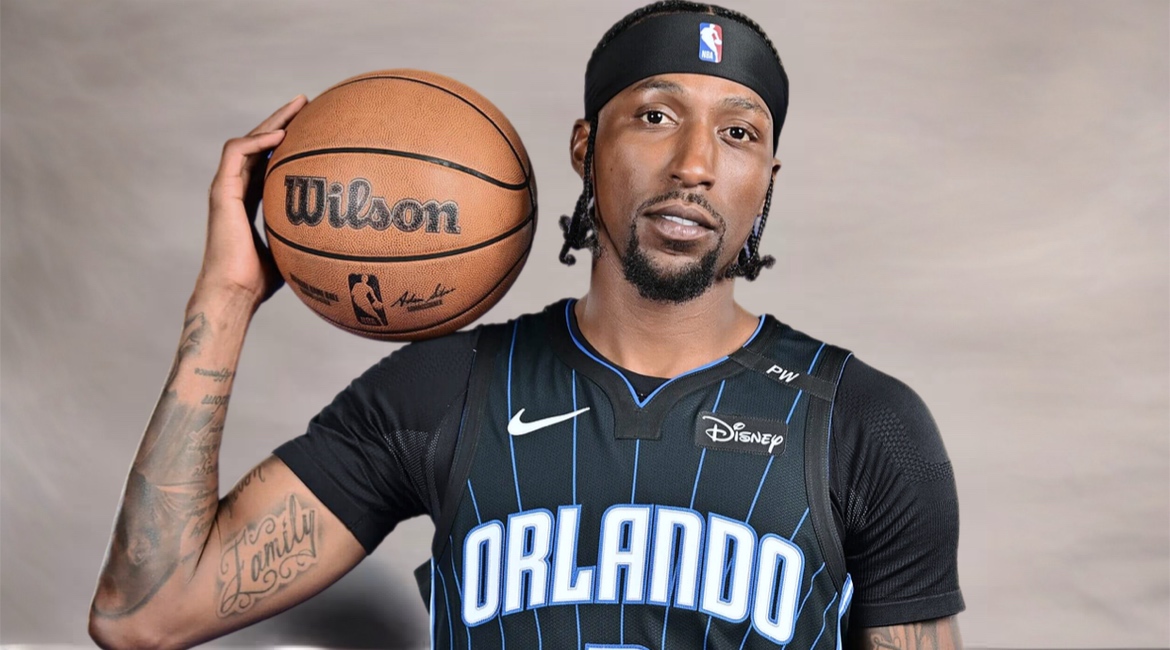
In a way, he already has. He’s spent almost two decades demonstrating the ability to guide his teammates and reach them like a player-coach. Players know how powerful that skill is. Coaches know it, too. Front offices know that, including the decision-makers for the Orlando Magic. And nearly one year before Gaines asked Caldwell-Pope about his post-career plans, acquiring someone with that skill was top of mind for the Magic.
The Magic were a very young roster at the time. Their top players had plenty of talent, but very little professional basketball experience to accompany it. Their experience with postseason basketball peaked with a Game 7 in the first round against the Cleveland Cavaliers. If they had any hope of going any further, they needed to shift this roster into a group that could withstand the brutal road necessary to do so. That would require adding people that not only understood the skills that take most young players years to learn, but people who could communicate and teach those skills to a group about to rely heavily on the talents of 21-year-old Paolo Banchero, 22-year-old Franz Wagner, and 23-year-old Jalen Suggs.
If this sounds familiar, it should. That’s the exact environment that Caldwell-Pope walked into when he signed with the Los Angeles Lakers for the first time. Six years and two championship rings later, the Orlando Magic wanted their young roster to run with him.
“Coaches, management, performance — everyone raves about him,” Magic President of Basketball Operations Jeff Weltman told reporters shortly after signing the guard. “And having spent the last couple of days with him, I understand why.”
A fine outcome given that his current team was preparing to go in a different direction. And all of a sudden, Caldwell-Pope’s new direction appeared to be about 2,000 miles southeast. That young Magic roster was worth the distance. The chance to play with a rising superstar in Paolo Banchero? And an ascending multi-skilled star forward in Franz Wagner? Two young stars surrounded by a roster that nearly had the second round in their fingertips on their first playoff run together? That ticket to MCO might as well have been booked the prior day.
“Seeing their progress, making it to the playoffs, taking Cleveland to a Game 7, that was enough for me,” Caldwell-Pope said during his first press conference as a member of the Orlando Magic. “They got a little bit of a taste of that pressure, what it takes to make it past the first round. I’m just excited to be a part of it.”
A deal was made. Caldwell-Pope signed a three-year, $66 million contract with the Magic in July of last year. He was ready to compete with a young roster dying to experience the postseason success he had already achieved, and he made it his mission to bring them there. And not just through his play on the court. He certainly planned on showing his opponents the shooting and defense that got him this far, but he was very intentional about giving his teammates the leadership and guidance that had brought his teams even further.
“My expectations for the team were to come in and make everyone better,” Caldwell-Pope told Orlando Magic HQ in January, “To change their mindset on how to approach games and [take] it a level up from where they were last year to become a championship team, and just continue to be that leader for them guys.”
Caldwell-Pope arrived at his first practice at the AdventHealth Training Center carrying more than a decade of basketball experience. Some of the people he now stood alongside were middle schoolers when Caldwell-Pope received his first piece of NBA advice. A good number hadn’t even graduated high school by the time Caldwell-Pope won his first championship. There was a lot for them to learn. Not about basketball, but the little things that most players don’t often learn until after they reach the NBA. The little things that gave Caldwell-Pope the long career he’s had so far.
So the eleven-year veteran made it a priority toteach his new teammates about these little things. He taught them the importance of being ready as soon as their number gets called. He advised them to slow the game down and let the game come to them. He preached the same virtue of patience that his children taught him, and he approaches his teammates with the same compassion as he does his own kids. Of course, these teammates are not his biological children. They don’t need to be. All of those lessons still come straight from the heart of a loving father figure who wants nothing but the best for this group of guys he cares for and sees so much potential in.
“Watching them play and being relentless on both ends made my choice pretty easy,” Caldwell-Pope told reporters in his first press conference with the Magic. “I just wanted to come in and fit right into this organization and just do what I do: shoot the ball and play defense.”
It’s a good thing that Caldwell-Pope gave them this advice. The young guys received their first pop quizzes on these lessons as soon as the season began. Rookie Tristan da Silva heard his name called to replace the productivity of an injured Banchero just five games into his NBA career, and he responded that very next game with 17 points off of 6-for-8 shooting. Anyone who watched a Magic game last season could see the raw emotions that flustered Anthony Black’s face after crucial late-game mistakes. His teammates praised the now-sophomore after he comfortably and confidently hit a game-winning three-pointer against the Indiana Pacers, the eventual Eastern Conference champions.
Each of the Magic’s three best players missed significant time with various injuries, sometimes all three at the same time. Yet the players who remained still found ways to stay confident, focus solely on the future, and win games that they should not have even made close.
“You don’t want to be that person when your number is called and you aren’t ready,” Caldwell-Pope told Orlando Magic HQ in January, and some of his teammates. “So always be ready and have a mindset that ‘I’m going to go out there and get it.’”
Injuries aside, just about everyone on this Orlando Magic roster seemed to be having better seasons than the ones they had the prior year. Everyone … except for Caldwell-Pope. He started in each of the 77 games he played in that season, one of the few players on the roster who avoided a bite from the injury bug. But those games weren’t perfect. He averaged a decade-low8.7 points that season off of 43.9% shooting from the field, with just 2.2 rebounds and 1.8 assists. The defense came as advertised with 1.3 steals, but he only connected on 34.2% of his three-point attempts. That’s a good number for many NBA players, but not what you’d expect from a player who shot 40.6% from long-distance just one year before.
Caldwell-Pope has thought about it even long after the season ended. As recently as early June, he’s talked with some of his closest friends about what he needs to tweak in order for a season like that not to happen again. What should he do to get his efficiency back up? What needed to change in his mindset to refocus ahead of the next season? He felt he owed his team that much, and he prepared to spend his summer making that work. Not just because they invested millions of dollars into him. He didn’t want to let down a city, a team, and a community that he’d fallen very fast in love with. Caldwell-Pope truly believed that the Magic have a roster well-equipped to win a championship. He wouldn’t have bought a house and relocated his family to Orlando if he hadn’t. He was going to bring a winning culture to Orlando. In any way that needed to happen.
“He really wants to win down here,” Gaines said. “We talk about that all the time. He’s like, ‘Bro, we’ve got to find a way to win. We got the pieces, from the youth, to the talent that the youth have, they have the pieces to actually do it.’”
Gaines didn’t doubt that for a second. He’s known for more than a decade just how hard Caldwell-Pope works in pursuit of his goals, and he’s seen it for himself while sitting behind him as a freshman. He was reluctant to do so at first. Gaines arrived in Athens ready to show the world his talent, but he did as he was told. That gave him a chance to watch Caldwell-Pope deal with the emotional pains that often accompany the difficult games, national attention, and immense pressure he faced as a top NBA Draft prospect. That inspired Gaines to develop a work ethic and level of maturity that closely resembled that of his friend. Doing so strengthened his mindset and gave him the mental fortitude he needed to overcome not just the obstacles as a college athlete, but even far beyond his professional career.
That mindset was the subject of the Father’s Day sermon he gave at his mother’s church. At one point, Gaines mentioned Caldwell-Pope as someone he learned a lot from just by watching. He intended for his sermon to be a message to his members that no matter how bleak things may seem, the right pivot can shift just about everything. And for Gaines, that pivot made him a better player and a better person.
Service ended not long after Gaines’ sermon. It felt so good for him to get that off his chest. And who knows? Maybe someone listening stored his words in their heart. It appeared as if someone did. As people started to file out of the church’s doors and walk toward the parking lot, one member went the opposite direction. He found Gaines and approached him before earning his attention.
“Hey, did you know that your friend just got traded?”
It took Caldwell-Pope’s agent multiple calls to deliver this news to him. Caldwell-Pope’s phone wasn’ta concern for him. It would have distracted him from the boat he took his family aboard for Father’s Day. He only noticed the several missed calls when he reached into his bag for something. But the phone suddenly captured his attention. His agent never calls him multiple times. So he dialed him back. His agent picks up. A few seconds in, Caldwell-Pope solemnly understood the reason for the frantic call.
The rest of the world found out the news when Gaines did. The Magic just traded Caldwell-Pope, alongside Cole Anthony, four unprotected first-round picks, and a pick swap to the Memphis Grizzlies in exchange for Desmond Bane.
This wasn’t Caldwell-Pope’s first trade. Two other teams have shipped him somewhere else throughout his career. But this one stung. Caldwell-Pope already missed the strong rapport he built with his younger teammates. He really wanted to win a third championship with this Magic roster and give those players the feeling he first felt five years ago. And whenever it came time to leave his career behind, he would have hesitated to leave Orlando. Those close to Caldwell-Pope say that he loved living there, adored its energy and weather, and viewed the city as a great place to settle down. He wasn’t alone. They also say that McKenzie loved the city and that they already enrolled their children in school there. Now he had to tell that family, on Fathers’ Day, that this perfect fit was no longer reality.
This trade will make Orlando the latest city that Caldwell-Pope leaves behind on his basketball journey. The latest of the many cities whose residents have learned something from being around him. In Los Angeles, his young teammates learned how to prepare for the NBA, and Clay Moser learned how to better reach them using examples of players who have been there before. Todd Okeson learned what betting on yourself can look like when a risk pays off. Philip Pearson learned how much dedication goes into recruiting a highly touted player, and Sean Hayes learned how to help these types of players achieve a potential that neither could have foreseen. Even Mark Fox, who has coached college basketball programs since 1991, believes Caldwell-Pope has made him better at his job.
Not all of Caldwell-Pope’s lessons are about improving at work. Some impact lives and families. As a high school basketball coach, Sherrard Brantley teaches young players many of the same lessons that Caldwell-Pope mastered at such a young age. Charles Mann Jr. learned how to be a strong leader through example and compassion, something he’s used in his new career as the program’s director of player development. Kenny Gaines learned how to be a good father by just watching Caldwell-Pope and asking him questions that he knew best. The first time he watched Caldwell-Pope, he only received emotional strength that would fend off his inner struggles and save his life many years later.
Though fewer people have been impacted by Caldwell-Pope than the first community he ever knew. Richard Carter learned how to be patient just from watching Caldwell-Pope’s calm demeanor on the court. Kenzie Gates learned that humility can be found even in such a young boy. It’s no surprise to her that this young boy would grow up to be an NBA champion. Or that this young boy would return to Greenville after winning his second championship, and be greeted with a parade thrown by the city that raised him. Or even that the city would remodel and rename the court near the elementary school after the young boy who spent much of his afternoons playing on it with his best friend.
That young boy is now a father of five and a loving husband to McKenzie. They’ll stay in Orlando for the foreseeable future as Caldwell-Pope supports them from afar. Though it will probably be without the family car, he told Gaines that he will probably leave it in Orlando for McKenzie and find something new to drive. The day will soon come for him to pack up that new car and join his brand-new teammates, his brand-new organization, and his brand-new city in Memphis. He will drive a road that his tires haven’t gotten used to yet, but that’s okay. He’s taken many new routes outside of Greenville throughout his life. And every time he does so, the Meriwether County Courthouse still sits proudly in the middle of his town’s square. So do the many lives he’s touched ever since Fox and Pearson drove to Greenville on that Friday morning 15 years ago. They all know he’s not leaving anything behind. He’s just continuing to push himself forward.
And he’s never been known to take his foot off the gas.
“We’re behind him,” Mann said. “His circle is behind him, and we’re rocking with him no matter what.”